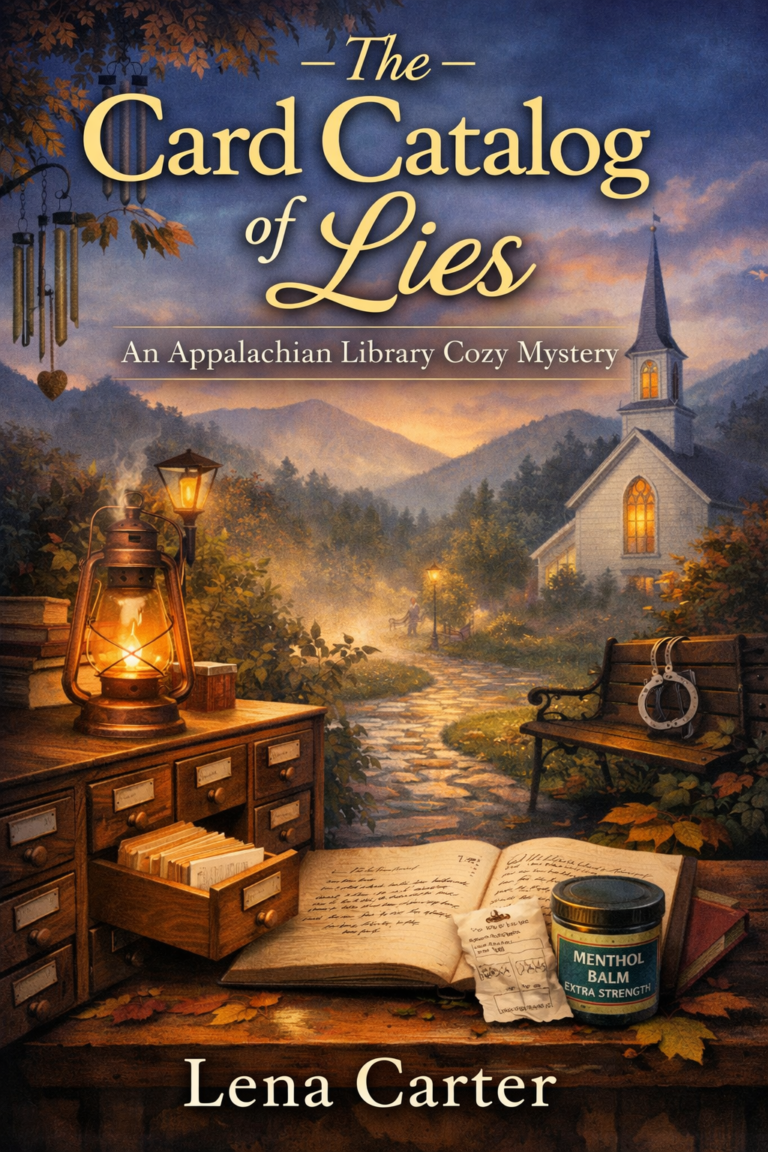
The Card Catalog of Lies by Lena Carter — A Complete Review
What Is The Card Catalog of Lies About?
The Card Catalog of Lies is a character-driven Appalachian cozy mystery centered on Kevin Greene, a principled head librarian who discovers a bloodstained library card tucked inside a misfiled book. Within 24 hours, a powerful library benefactor dies in what appears to be a tragic fall in the town’s reading garden.
As Kevin traces old due-date stamps, restricted borrower histories, and archived memorial fund records, he uncovers a decades-old financial scandal that powerful townspeople have carefully buried.
This novel explores a powerful question:
What happens when a quiet librarian chooses truth over stability?
Why This Cozy Mystery Stands Out
Many cozy mysteries rely on charm and eccentric suspects. The Card Catalog of Lies does that — but it also adds layered moral tension.
What makes this book distinctive:
- The sleuth is a librarian, not a baker or café owner
- The mystery revolves around records, ledgers, and archival truth
- The Appalachian setting is atmospheric, not stereotypical
- Financial corruption and social control are central themes
- The pacing is deliberate and immersive
The story values relationships and town dynamics over fast twists. It builds suspicion through conversations, subtle clues, and social power plays rather than shock value.
Appalachian Atmosphere & Setting
The setting of Briar Hollow feels authentic and lived-in. The reading garden, church steeple, small café, and historic archives form a tight ecosystem where everyone knows everyone — and secrets echo.
Key sensory elements woven throughout the novel include:
- Fog rolling over stone steps
- The scent of menthol balm and lemon oil
- The hum of fluorescent lights in an after-hours library
- Rain tapping against tall windows
- The soft click of a catalog stamp
The environment becomes an active participant in the mystery.
Main Characters
Kevin Greene
A morally grounded librarian who believes records protect truth. His quiet persistence drives the investigation.
Mara Pruitt
Archivist and emotional anchor of the story. Guarded, intelligent, and deeply tied to the town’s history.
Sheriff Eunice Kline
Pragmatic and burdened by public perception. She must decide whether law or stability comes first.
Hazel Voss
Heir to the town’s philanthropic empire. Polished, persuasive, and committed to narrative control.
Supporting Characters
Darla Finch, Eli Finch, Reverend Calvin Mott, and Deputy Silas Rook all add moral complexity to the unfolding investigation.
Table of Contents
Below is the complete chapter structure of The Card Catalog of Lies:
| Chapter | Title |
|---|---|
| 1 | Misfiled |
| 2 | The Fall |
| 3 | Stamped Dates |
| 4 | The Scent of Menthol |
| 5 | The Ledger Page |
| 6 | Altered Records |
| 7 | The Missing Book |
| 8 | After-Hours Footsteps |
| 9 | Framed |
| 10 | The Influence Notebook |
| 11 | The Page That Isn’t Supposed to Exist |
| 12 | The Garden Confrontation |
| 13 | The Book That Wouldn’t Fall |
| Epilogue | Restacked Shelves |
The progression follows a classic cozy mystery arc:
- Discovery
- Escalation
- Record tampering
- Community tension
- Moral reckoning
Each chapter builds through dialogue and layered revelations rather than dramatic spectacle.
Themes Explored in the Novel
1. Truth vs. Stability
The novel questions whether protecting a community’s image justifies burying uncomfortable facts.
2. Power Through Information
Lenora Voss weaponizes documentation and influence. Control is maintained through records.
3. Generational Secrets
The mine memorial fund scandal ties past and present together.
4. Moral Courage
Kevin’s arc centers on choosing integrity despite financial and social consequences.
Who Should Read This Book?
This book is ideal for readers who enjoy:
- Traditional cozy mysteries
- Library or bookshop mysteries
- Small-town crime fiction
- Appalachian settings
- Slow-burn investigative plots
- Clean mysteries with no graphic violence
Fans of character-focused mysteries will especially appreciate the emotional depth.
Strengths of the Novel
✔ Strong atmospheric setting
✔ Intelligent plot built on documentation and records
✔ Meaningful moral dilemmas
✔ Compelling female characters
✔ Clean and non-graphic storytelling
✔ Satisfying resolution with emotional closure
Potential Considerations
Readers looking for fast-paced, action-heavy thrillers may find the pacing intentionally slower. This novel prioritizes conversation, tension, and layered revelations.
That said, the final confrontation delivers emotional intensity without sacrificing the cozy tone.
Is The Mystery Fully Resolved?
Yes. By Chapter 13 and the epilogue, the mystery surrounding Lenora Voss’s death and the memorial fund scandal is fully explained. The book concludes with accountability, emotional closure, and the library reclaiming its role as a refuge of truth.
Frequently Asked Questions (FAQ)
How many pages is the book?
The novel is 196 pages long.
Is there graphic violence?
No. This is a traditional cozy mystery with no graphic descriptions.
Who is the main protagonist?
Kevin Greene, the head librarian of Briar Hollow.
Does the story involve real historical events?
No, but it draws inspiration from Appalachian community dynamics and small-town governance structures.
What makes this different from other cozy mysteries?
The investigative method relies heavily on archival research, catalog systems, and financial documentation rather than amateur sleuth antics alone.
Is the ending satisfying?
Yes. The emotional and legal threads are resolved clearly, while leaving room for future installments.
Final Verdict
The Card Catalog of Lies succeeds as both a cozy mystery and a moral exploration of truth in small communities.
It asks an important question without preaching:
What is a library for — comfort, or truth?
Lena Carter crafts a thoughtful, atmospheric mystery that rewards patient readers. It is ideal for fans of intelligent small-town fiction that blends archival intrigue with emotional stakes.
If you’re searching for an Appalachian cozy mystery about secrets, ledgers, and the courage to turn the right page — this novel deserves a place on your shelf.