If you’ve ever looked at the night sky and felt a sense of wonder, Mark Wilkins’ 2026 sci-fi thriller, The Day the Sky Turned Hollow, will make you want to close your blinds and double-check your locks. This isn’t just another alien invasion story; it is a clinical, terrifyingly beautiful account of a world being “unplugged” and rewritten by an ancient, deliberate force.
 The Day the World Went Silent
 The Day the World Went Silent
The story kicks off in the town of Briar’s Edge at exactly 2:17 a.m.. In an instant, every electronic device dies, and even the natural sounds of the world—insects, wind, and trains—vanish. Wilkins does a masterful job of building tension not through explosions, but through the “metallic tang” of scorched wires and the haunting sound of every dog in town mourning the loss of the stars.
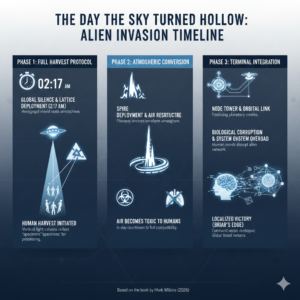
Caleb Ward, our protagonist, wakes up to a sky that is no longer empty. Instead, a hexagonal lattice is tessellating across the atmosphere like a honeycomb shell, sealing the planet away from the universe. This “sky engineering” is the first step in what the invaders call the “Full Harvest Protocol”.
A Father’s Desperate Mission
The emotional core of the book is Caleb’s relationship with his daughter, Lily. When a seven-foot-tall being with ” grown” armor and light-filled faceplates shatters their front door and abducts Lily, the stakes become agonizingly personal.
What makes this book stand out is the depiction of the “Harvest”. It isn’t a massacre; it’s a collection. People aren’t being killed—they are being converted into energy and data, suspended in vast chambers of light to serve as biological processors for the alien network.
The Phases of the End
As the story progresses, we learn that the invasion is a multi-step process:
- The Harvest: Using vertical columns of light to collect “specimens” from population centers.
- Phase Two (Atmospheric Conversion): Deploying planetary “anchors” or spires to restructure the air, making it toxic to humans but compatible for the invaders.
- Terminal Integration: Linking a massive orbital command vessel to the ground-based node towers to finalize the planetary rewrite.
Why I Loved This Book
The turning point for me was Caleb’s discovery that humans aren’t just victims; we are “contamination”. The alien system is built on clinical precision, and it cannot handle the “biological architecture incompatibility” of human emotion and chaotic thought. Caleb’s final stand—turning his own memories and love for his daughter into a “cognitive virus” to overload the network—is one of the most satisfying sci-fi climaxes I’ve read in years.
Wilkins ends the book on a note of “broken spears”. While the invasion isn’t over, the sky belongs to Earth again—for now.
Frequently Asked Questions (FAQ)
What is the “hexagonal lattice” in The Day the Sky Turned Hollow? The lattice is an artificial, planetary-scale structure that seals Earth’s atmosphere, serving as the primary infrastructure for the alien invasion and energy distribution.
How do the aliens in the book “process” humans? The invaders use a “Harvest Protocol” to convert human biological mass and neural patterns into energy and data, integrating people into their planetary network.
Can the alien armor be defeated by human weapons? Standard ammunition is usually absorbed by the armor, but Caleb Ward discovers that the composite plating is vulnerable at the “seams” and joints if the armor is already damaged.
What is the main goal of the alien invaders? The invaders are not looking for conquest in the traditional sense; they are performing a “planetary restructure” and “harvest,” essentially turning Earth into a functioning node within an ancient, vast machine.
Does Caleb Ward find his daughter Lily? Yes, Caleb manages to pull Lily back from the “Gate of Light” by destabilizing the containment field with his own biological interference.
What is the role of Fort Halberd in the story? Fort Halberd was the location of the initial human military resistance, which lasted less than twenty minutes before the base was erased by a column of white light and replaced by the central Node Tower.
How does Phase Two of the invasion affect Earth? During Phase Two, the invaders adjust the atmospheric composition through molecular restructuring, aiming for “full compatibility” with their own biology within six days.
Who is the author of The Day the Sky Turned Hollow? The book is written by Mark Wilkins and was published in 2026.
Alien Node Tower: Technical Specifications
Classification Central Planetary Processor / Node
Primary Function Coordinates the hexagonal lattice, planetary spires, and atmospheric conversion.
Height Reaches into the upper atmosphere to lock directly into the orbital lattice
Construction Composed of interlocking, unfolding biological-metallic plates
Energy Source Biological Neural Networks (Suspended human “anchors”)
Power Distribution Vertical energy shafts connected to concentric rings of “specimens”
Defensive Systems Non-lethal compliance fields, telekinetic pressure fields, and armored patrol units
Vulnerability Cognitive corruption and biological architecture incompatibility

-

The Invisible Barrier
£3.99 Add to cart -
Sale!
The Wall Before the Fire
Original price was: £7.99.£3.99Current price is: £3.99. Add to cart -
Sale!
The Bedtime Ceasefire
Original price was: £7.99.£3.99Current price is: £3.99. Add to cart -
Sale!
Harbor of False Promises
Original price was: £9.99.£4.99Current price is: £4.99. Add to cart -
Sale!
The Grocery Store Meltdown Survival Guide
Original price was: £7.99.£3.99Current price is: £3.99. Add to cart