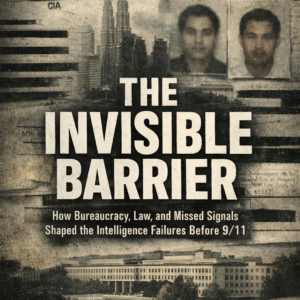
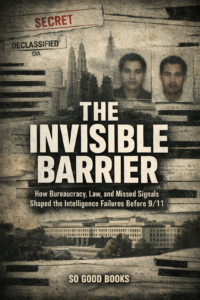
 The Invisible Barrier is a powerful and carefully constructed work of historical non-fiction that examines one of the most consequential intelligence failures in modern American history. Rather than retelling the events of September 11, 2001 from a broad public perspective, this book narrows its focus to the internal logic of the CIA’s Counterterrorist Center between 1999 and 2001. That choice gives the book its strength. It is not just about what happened. It is about how institutions think, how warning signals are processed, and how bureaucratic structure can turn fragmented knowledge into irreversible failure.
What makes this book especially compelling is its perspective. Instead of relying on sensationalism or hindsight-heavy accusation, it reconstructs the world as CIA headquarters officers, analysts, legal gatekeepers, and interagency actors would have experienced it in real time. That method makes the book feel more serious and more unsettling. Readers are not asked to watch history collapse from a distance. They are asked to sit inside the machinery of analysis, cable traffic, legal caution, and selective disclosure, where critical decisions were shaped by policy culture as much as by facts on the ground.
From a reader’s standpoint, this book performs well because it answers the exact questions many readers are already asking online: What was the CIA-FBI wall before 9/11? What happened at the Malaysia Summit? Why were Khalid al-Mihdhar and Nawaf al-Hazmi not fully tracked before the attacks? How did intelligence failures contribute to 9/11? The Invisible Barrier is built around those questions, and it answers them in a way that is detailed, readable, and grounded in declassified records, the Joint Inquiry, the 9/11 Commission Report, and CIA Inspector General findings. That makes it highly relevant not only to readers but also to search-driven discovery, because it aligns with real informational intent.
The book’s greatest achievement is the framework it uses to organize the story. By tracing the “Five Phases of Structured Failure,” it turns a complex intelligence history into a coherent narrative without oversimplifying it. Readers can see how signals emerged, how legal and bureaucratic constraints hardened, how moments of decision were delayed or mishandled, how operational drift replaced corrective action, and how the final consequences became visible only after it was too late. This structure makes the material easier to follow while preserving the seriousness of the subject.
Another strength is the book’s tone. It reads like premium narrative non-fiction rather than a dry policy report, yet it remains disciplined in its use of facts. The prose is serious, immersive, and analytical. It avoids invented dialogue and instead relies on documented events, named figures, verified dates, and public records. That gives the book credibility, which is essential for readers looking for trustworthy books on 9/11 intelligence failure, CIA history, FBI counterterrorism, or declassified U.S. national security history.
The chapters on the Malaysia Summit and the decision not to share intelligence are particularly effective. These sections show how the issue was never simply a lack of information. The problem was that key intelligence was observed, recorded, and understood in part, but not converted into broader operational action. The book makes clear that the wall between intelligence and criminal investigation was not just a legal rule. It became a working mindset. That is one of the most important insights in the entire work, and it gives the narrative lasting value for readers interested in institutional failure beyond this one case.
The review would be incomplete without noting how effective the book is as an educational resource. It is highly suitable for readers of political history, intelligence studies, terrorism studies, investigative history, and public policy. It would also appeal to readers searching for books about the CIA and FBI before 9/11, the road to 9/11, intelligence breakdowns, or the hidden history behind national tragedies. Because it speaks directly to those topics, it is also well positioned for answer engine optimization. It does not bury the subject. It addresses it directly and comprehensively.
If there is one reason this book stands out, it is because it treats the reader as someone capable of understanding complexity. It does not flatten the story into heroes and villains. Instead, it shows how intelligent and well-meaning professionals, operating inside a flawed system, can make choices that become catastrophic when combined. That gives the book a deeper relevance. It is not just a history of 9/11. It is a history of how systems fail when responsibility is fragmented and caution outruns action.
Table of Book Contents
| Section | Title |
|---|---|
| Introduction | Introduction |
| Chapter 1 | The First Signals: Tracking al-Qaeda Before the Break |
| Chapter 2 | The Malaysia Summit: Observation Without Action |
| Chapter 3 | The Wall as Structure: Law, Policy, and Fear |
| Chapter 4 | The Decision Not to Share |
| Chapter 5 | Entry Into the United States |
| Chapter 6 | Signals Escalate: The Summer of Threat |
| Chapter 7 | Late Recognition: The August Search |
| Chapter 8 | Structural Paralysis |
| Chapter 9 | September 11: Consequence |
| Chapter 10 | Accountability and Reform |
| Back Matter | Appendix |
FAQ
What is The Invisible Barrier about?
The Invisible Barrier is a historical non-fiction book about the intelligence failures before 9/11, focusing on the CIA’s Counterterrorist Center, the CIA-FBI wall, the Malaysia Summit, and the missed opportunities to track Khalid al-Mihdhar and Nawaf al-Hazmi before the attacks.
Is this book based on real records?
Yes. The book is built around declassified files, verified public records, the Joint Inquiry, the 9/11 Commission Report, and CIA Inspector General findings.
Who should read this book?
This book is ideal for readers interested in 9/11 history, intelligence and espionage, FBI and CIA operations, counterterrorism, U.S. political history, and national security decision-making.
Does this book take a conspiracy approach?
No. The book is grounded in documented historical evidence and focuses on institutional logic, bureaucratic failure, and real decision-making rather than speculation.
Why is the Malaysia Summit important in this book?
The Malaysia Summit is central because it brought together key al-Qaeda operatives, including Khalid al-Mihdhar and Nawaf al-Hazmi, and generated intelligence that was observed but not fully shared or acted upon in time.
What makes this book different from other 9/11 books?
Its main difference is perspective. It examines the pre-9/11 intelligence breakdown from inside the CIA headquarters environment, focusing on structure, law, policy, and decision-making rather than only recounting the attacks themselves.
Is this book good for research or academic interest?
Yes. While it is written in an accessible narrative style, it is highly useful for readers studying intelligence failure, counterterrorism policy, interagency coordination, and modern American history.