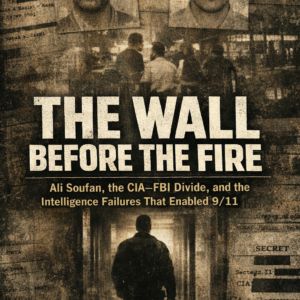
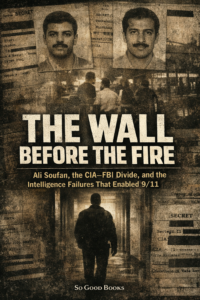
 The Wall Before the Fire: Ali Soufan, the CIA–FBI Divide, and the Intelligence Failures That Enabled 9/11 is a meticulously structured nonfiction investigation that examines one of the most consequential intelligence failures in modern history. This book stands out not as a speculative narrative, but as a disciplined reconstruction of documented events, grounded in verifiable sources such as the 9/11 Commission Report, Joint Inquiry findings, and declassified CIA and FBI materials.
At its core, this book answers a critical question readers often search for: “Could 9/11 have been prevented?” Rather than offering simplistic conclusions, it provides a layered, evidence-based analysis showing how known intelligence signals failed to converge due to institutional barriers.
What Is This Book About?
This book explores how FBI Special Agent Ali Soufan’s real-world investigations into al-Qaeda intersected with critical intelligence that was never fully shared with him. It reveals how the CIA’s knowledge of key operatives—Nawaf al-Hazmi and Khalid al-Mihdhar—was not effectively transmitted to the FBI, allowing them to live inside the United States before the attacks.
Key Themes and Strengths
One of the book’s strongest elements is its structured analytical framework—the Barrier Intelligence Breakdown Model—which is applied consistently across every chapter. This framework transforms what could be a complex web of intelligence failures into a clear, traceable sequence:
- Signals were identified
- Information was fragmented
- Operational friction slowed action
- Convergence opportunities were missed
- Consequences followed
This approach makes the book highly effective because it directly addresses how and why events unfolded, rather than simply describing them.
The focus on Ali Soufan’s field experience adds a grounded perspective. His work on cases like the USS Cole bombing demonstrates how much intelligence was actually uncovered through traditional investigative methods. The contrast between what was known in the field and what was withheld at higher levels becomes one of the book’s most compelling insights.
Table of Contents
| Chapter | Title |
|---|---|
| 1 | The Early Signals: East Africa to Yemen (1998–2000) |
| 2 | The Malaysia Summit: Surveillance Without Transmission |
| 3 | Entry into the United States: Known but Untracked |
| 4 | The USS Cole Investigation: Soufan’s Expanding Map |
| 5 | The Wall in Practice: Legal and Institutional Separation |
| 6 | The Withheld Cable: August 2001 Breakdown |
| 7 | The Search That Came Too Late |
| 8 | September 11, 2001: Convergence of Failures |
| 9 | The Investigations: Accountability and Findings |
| 10 | After the Wall: Structural Reform and Legacy |
| Appendix | Continuing the Record |
Why This Book Is Important
This book is particularly valuable because it avoids sensationalism. Instead, it focuses on documented facts, including:
- The January 2000 Malaysia summit surveillance
- The CIA’s knowledge of Mihdhar’s U.S. visa
- The delayed FBI search in August 2001
- The structural “Wall” between intelligence and law enforcement
By anchoring every claim in verifiable records, the book builds credibility and trust.
It also clarifies a common misconception: the issue was not a lack of intelligence, but a failure to integrate it. That distinction is critical for understanding modern national security challenges.
Who Should Read This Book?
This book is ideal for:
- Readers interested in 9/11 history and intelligence analysis
- Professionals in law enforcement, intelligence, or policy
- Students studying national security or counterterrorism
- Anyone seeking a fact-based explanation of pre-9/11 failures
Strengths and Limitations
The primary strength of The Wall Before the Fire is its clarity and structure. Complex intelligence processes are broken down into understandable stages without losing depth. The use of real names, dates, and documented events enhances its authority.
Another major strength is its discipline—the book does not speculate or dramatize. This makes it particularly effective for readers who want a reliable, research-driven account.
However, this same discipline may feel dense for casual readers. The book prioritizes accuracy over narrative embellishment, which can make it more analytical than emotional. For its intended audience, though, this is a strength rather than a weakness.
Frequently Asked Questions (FAQ)
What makes this book different from other 9/11 books?
This book focuses specifically on intelligence failures and information-sharing breakdowns, using a structured analytical framework rather than a broad historical overview.
Is this book based on real events and sources?
Yes. All content is grounded in verified public records, including the 9/11 Commission Report, Joint Inquiry findings, and declassified intelligence documents.
Who is Ali Soufan and why is he important?
Ali Soufan is an FBI Special Agent who investigated al-Qaeda before 9/11, including the USS Cole bombing. His work provides a real-world perspective on what was known at the time.
What was the “Wall” between the CIA and FBI?
The “Wall” refers to legal and institutional barriers that limited information sharing between intelligence and law enforcement agencies prior to 9/11.
Could the 9/11 attacks have been prevented?
The book shows that critical intelligence existed but was not effectively shared or acted upon, leaving open the possibility that earlier intervention could have disrupted the plot.
Final Verdict
The Wall Before the Fire is a powerful, evidence-based examination of how intelligence systems can fail under pressure. It does not rely on speculation or hindsight bias, but instead reconstructs events using documented facts and structured analysis.
For readers seeking a clear, authoritative explanation of pre-9/11 intelligence failures, this book delivers both depth and clarity. It is not just a historical account—it is a case study in how systems operate, where they break, and what happens when critical information does not move in time.